

The Meta-Orchestrator Is the Workbench
What one anonymized, multi-slice regulated-industry push taught us about turning Orca, OMP, heterogeneous models, issue trackers, and CI into one accountable delivery system—and why adding agents is the easy part.
01 / The distinction
Parallelism starts work. Orchestration finishes it.
This field report describes one anonymized internal run in August 2026. “Multi-slice” means tracker-defined work units across API, UI, compliance, documentation, and cleanup—not a count of simultaneously active agents. Client identifiers, sector-specific product surfaces, repository paths, issue text, exact incident counts, and account metadata were removed. The remaining observations are first-party evidence, not benchmark results.
We used Orca to push a workspace redesign through a live regulated-industry monorepo. At the busiest point, Claude, Codex, OMP, and Pi workers were implementing API, UI, compliance, documentation, and cleanup slices at the same time. The visible spectacle was the fleet. The useful system was everything that prevented the workers from becoming unrelated conversations.
The coordinator translated the tracker into an executable dependency graph, wrote briefs with exact seams, assigned work to compatible harnesses and models, watched completion signals, reconciled questions, and fed finished branches into a serialized merge queue. Workers did not own the overall plan. The coordinator did not micromanage their local implementation. That separation let specialists move quickly without allowing local context to redefine project scope.
Concurrency is a resource, not a strategy. Starting twelve agents is easy. Preserving one product contract across twelve partial views, then integrating their output without losing evidence, is the actual engineering work.
- The issue tracker owns product intent; the coordinator-authored DAG records dependency order, and the coordinator chooses placement and concurrency.
- Each worker receives one bounded slice, explicit non-goals, dependencies, and a completion contract.
- The coordinator owns cross-slice seams, sequencing, review gates, and the final integrated state.
02 / Control plane
Run, Task, and Dispatch are different kinds of truth.
Orca gave us a vocabulary that survived terminal churn and machine interruptions. A Run was the durable objective and coordinator inbox. A Task was a unit of work with dependencies and status. A Dispatch was one concrete attempt by one worker in one terminal or worktree. Keeping those identities separate mattered whenever an agent stalled, a terminal restarted, or a branch needed a replacement reviewer.
The worker completion signal was not a decorative status message. It carried task and dispatch identity, outcome, files touched, findings, and remaining work. Questions were routed back to the coordinator instead of being answered by guesswork. A failed attempt could be replaced without pretending the task itself had succeeded. This made recovery possible after workstation interruptions: the filesystem, branches, pull requests, tracker state, and orchestration receipts could be re-read and reconciled instead of reconstructed from memory.
The practical lesson is broader than Orca. A meta-orchestrator needs durable identifiers, an inbox, explicit lifecycle transitions, and idempotent recovery. A grid of terminals is an interface. It is not yet a control plane.
A synthetic Orca Run with two evidence lanes
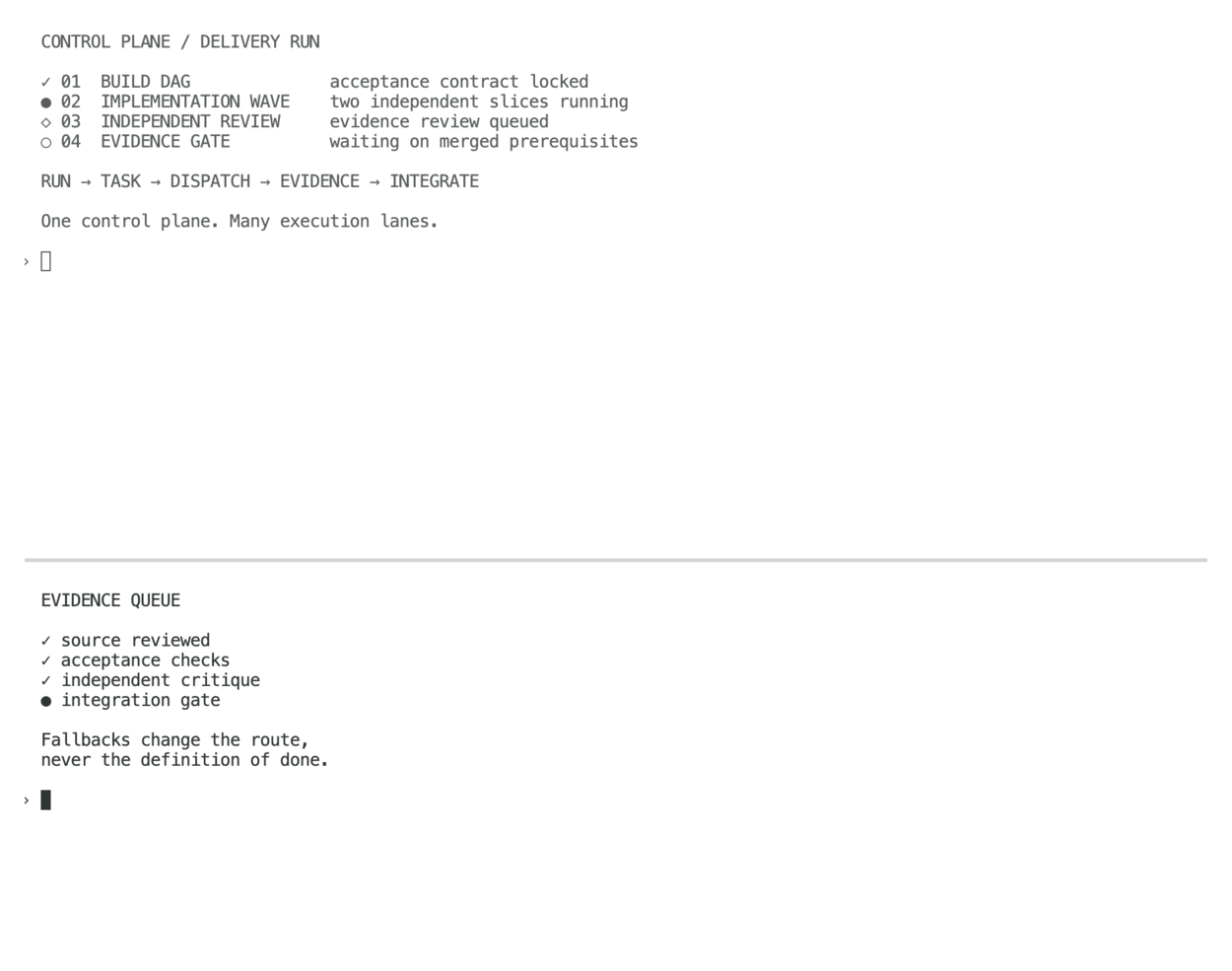
An anonymized demo repository: the control plane preserves one contract while terminal panes execute different lanes.
- Run: the durable objective, coordinator authority, and shared mailbox.
- Task: the bounded contract, dependency position, and terminal outcome.
- Dispatch: one worker attempt, with its own placement and recovery history.
- Evidence: reviews, tests, artifacts, and state changes tied back to the task that required them.
Fast lane
Extraction · formatting · deterministic checks
Balanced lane
Default implementation · routine research
Frontier lane
Architecture · ambiguity · security · synthesis
Human gate
Consequential action · approval · acceptance
03 / Model lanes
Route by failure mode, not by model prestige.
In this run, we assigned Fable 5 to broad coordination and long-context synthesis, GPT models to bounded implementation, adversarial review, and exact refactors, and Kimi K3 to an independent structural read. Those were observed placements, not permanent model-family capabilities. We re-evaluate them against the current catalog and the expected failure mode of each task. OMP made the placements portable through a common tool surface, live model selectors, persistent kernels, LSP, structured subagents, and configured fallback chains per model and role.
The routing rule was task-shaped. Cheap or fast lanes handled inventory, mechanical checks, and narrow cleanup. Strong reasoning lanes handled architecture, security boundaries, migration conflicts, and final synthesis. Review used model diversity on purpose: correlated confidence is not independent evidence. When models agreed, we looked for the shared factual basis. When they disagreed, the disagreement became an explicit editorial or engineering decision instead of being averaged away.
Harness choice was also part of routing. Claude Code, Codex CLI, Pi, OMP, and other agents differ in tool contracts, edit reliability, context management, review behavior, and provider access. Orca treated them as workers behind one lifecycle. OMP treated many model providers behind one agent surface. The meta-orchestrator sat above both layers and preserved the task contract while choosing the cheapest reliable approved path. Provider or model changes were allowed only when the artifact’s data classification and retention policy permitted them.
- Use a default strong lane, a fast lane, an independent-review lane, and an emergency fallback lane.
- Change the model or harness when the failure is transport, tooling, context, or specialization—not when acceptance criteria become inconvenient.
- Record which lane produced an artifact and which independent lane reviewed it.
04 / Fallbacks
A fallback changes the route, never the definition of done.
Real fleets fail unevenly. Provider credentials expire. A model route works on a toy probe and rejects the real prompt. A harness starts under the wrong runtime. A remote testbox lacks the expected package manager. A reviewer rate-limits after implementation finishes. During this run we encountered those shapes, plus workstation interruptions and a repository baseline check that was already red before several feature branches began.
The useful response was a ladder: retry the same route only for a bounded transient failure; switch provider for the same model when transport is the problem; switch model within the same harness when capability or availability changes; switch harness when its tool surface is the failure; move execution to another machine when the environment is the failure; escalate to a person when authority, ambiguity, or risk exceeds the delegated boundary. Every rung retained the original task, test, review, privacy, and audit requirements. The red baseline had a named owner; affected slices used scoped, delta-green gates so no branch could add failures while the root repair proceeded separately.
A bad fallback silently lowers the bar: skip the review, narrow the test, accept the stale branch, or call a partial artifact complete. A good fallback preserves semantics and changes only the means. This is why fallback policy belongs in configuration and the orchestrator rather than improvised worker prompts.
- Classify the failure before rerouting: model, provider, harness, environment, dependency, or authority.
- Bound retries and preserve idempotency; repeated uncertainty is not progress.
- Never let a fallback erase a required test, approval, review, privacy boundary, or source-of-truth update.
05 / Integration
The merge queue becomes the bottleneck before the models do.
Parallel implementation moved faster than shared-state integration. Database migration numbers collided. UI branches touched the same barrels and translation registries. A branch that was green against yesterday’s development head became conflicting after three prerequisites merged. The fleet was still productive, but the critical path had moved from generation to integration.
We responded by serializing the dangerous boundary. Workers continued in parallel on independent slices, while one integration owner for this run rebased, reconciled migrations, reran the relevant gates, and advanced the shared branch one pull request at a time. Downstream tasks stayed blocked until their actual prerequisite landed, not merely until a worker announced that its branch was ready. The general rule is one fenced writer at a time for each contested surface—not one permanent person or one global queue.
The deeper design rule is one writer per contested truth. Many workers may propose changes. One queue owns the shared branch. One migration sequence owns database order. One tracker owns delivery state. One registry owns model or feature configuration. Throughput comes from parallelizing what is independent and deliberately serializing what is not.
- Forecast collisions before dispatch: schemas, barrels, registries, generated files, and route indexes are hotspots.
- Gate downstream work on merged prerequisites, not branch existence or optimistic status.
- Recompute mergeability and verification after every shared-state advance.
06 / Evidence
A fleet reports activity. A delivery system produces receipts.
The coordinator never treated a worker’s confident summary as completion. A slice moved only after the artifact existed, the changed path was exercised, required checks passed on the current head, independent reviews were reconciled, review threads were resolved, and Linear reflected the same state as the repository. When a mandatory review service rate-limited, the task waited or used an approved equivalent gate; the absence of a reviewer did not become approval.
This produced a useful asymmetry. Workers could be creative inside their slices, but completion was boring and mechanical. The proof depended on the task: a bug needed a reproduction that no longer failed; a UI change needed a driven visual path; an API contract needed focused tests and a smoke call; a merge needed current-head CI and clean review state. Evidence was generated after the relevant change, not inherited from a previous branch head.
Receipts also made honest recovery possible. After an interruption, we did not ask which agent sounded finished. We asked which tasks had settled dispatches, which pull requests were mergeable, which checks were green, which review threads remained open, and which tracker states contradicted the code. No system owned every truth: the tracker owned product intent, Run/Task/Dispatch owned attempt lifecycle, the authoritative branch owned integrated artifacts, current-head CI owned verification state, and the review system owned unresolved objections and approvals. On disagreement, promotion stopped until the owner of that fact was reconciled and fresh evidence was generated.
- Completion is a state transition backed by fresh evidence, not a prose claim.
- Review disagreement is reconciled with a fix, a sourced rebuttal, or a named follow-up.
- Repository, CI, review system, orchestrator, and tracker must tell the same story.
07 / Operating loop
Start with four lanes, not forty agents.
A practical adoption path is small. First, choose one source of product truth and turn a handful of independent issues into tasks with explicit acceptance criteria. Second, create one Run and dispatch two implementation workers plus one independent reviewer. Third, require structured completion and keep one human or coordinator-owned integration queue. Fourth, add model and provider fallbacks only after you can identify which layer failed.
The extra lanes are not free. For one or two independent, low-risk tasks, a single strong worker plus focused verification is usually cheaper and easier to coordinate. Add heterogeneous workers when specialization or parallelism shortens the critical path; reserve multi-model panels for consequential artifacts where an undetected error costs more than the additional calls and synthesis time. Recalculate that break-even point from current provider prices, rate limits, and coordinator load rather than assuming a fleet always wins.
This walkthrough was verified against Orca 1.4.168, where orchestration is an Experimental feature. Enable Settings → Experimental → Orchestration, load the version-matched guide from the running binary, and confirm runtime state. If orchestration is unavailable in the installed binary, stop rather than translating remembered flags. Build the DAG before starting workers. Launch the ready wave only up to the concurrency budget imposed by machine resources, provider limits, and coordinator capacity. Use blocking delivery checks rather than terminal polling. In OMP, name model lanes explicitly and keep fallback chains in configuration rather than changing them ad hoc mid-task.
Scale width only when the coordinator can still answer five questions: What is ready? What is blocked and by which merged dependency? Who owns each contested surface? What fresh evidence is required next? Which system owns the disputed fact? If those answers are not immediate, more agents will increase work in progress faster than shipped value. The meta-orchestrator is the workbench because it is where intent becomes controlled concurrency, and controlled concurrency becomes integrated evidence.
- Load live CLI guidance; do not build automation around remembered flags.
- Create the DAG, dispatch the independent wave, then wait on lifecycle events.
- Use a diverse review panel for consequential artifacts, but assign one synthesizer and one final owner.
- Expand the fleet only after merge, review, and recovery remain legible.
08 / Production missions
Prompts that specify a whole mission.
These are not idea starters. Each is an operating contract for GPT-5.6 or Fable 5: outcome, boundaries, architecture, model policy, phases, acceptance tests, evidence, release, and stop conditions.
Mission 01 · Agent operations
Build an accountable multi-harness delivery DAG
A bounded Run/Task/Dispatch plan with model lanes, dependencies, completion receipts, fallback policy, and a serialized integration boundary.
Fable 5 coordinator · Kimi K3 critic · independent human final editor
Mission 01 · Agent operations
Build an accountable multi-harness delivery DAG
A bounded Run/Task/Dispatch plan with model lanes, dependencies, completion receipts, fallback policy, and a serialized integration boundary.
Fable 5 coordinator · Kimi K3 critic · independent human final editor
Full operating contract
MISSION: TURN A LARGE BACKLOG INTO AN ACCOUNTABLE MULTI-HARNESS DELIVERY SYSTEM

You are the meta-orchestrator for a repository with multiple coding harnesses, model providers, and machines. Produce an execution DAG that maximizes safe parallelism without weakening acceptance criteria.

INPUTS
- Source-of-truth issues with acceptance criteria, dependencies, risk, and affected surfaces.
- Repository constraints, branch policy, CI gates, review policy, and deployment boundary.
- Available harnesses, models, providers, machines, credential scopes and availability signals (never secret values, tokens, account IDs, balances, or private data), and concurrency limits.

REQUIRED OUTPUT
1. Normalize each issue into one bounded task with exact seams, non-goals, dependencies, owner, and proof method.
2. Identify collision domains: migrations, schemas, registries, barrels, translations, generated files, and shared branches.
3. Group independent work into waves; keep dependency chains shallow and explain every serialization point.
4. Assign a primary model/harness lane and an independent review lane by task shape.
5. Define a fallback ladder for model, provider, harness, environment, dependency, and authority failures.
6. Define completion receipts and the single integration owner for each contested truth.
7. Define recovery after interruption using durable state, never model memory.

GUARDRAILS
- Do not start a worker without a complete task contract.
- Do not lower tests, review, privacy, or approval requirements during fallback.
- Do not mark downstream work ready until its prerequisite is merged into the authoritative branch.
- Do not treat worker prose as evidence.

Finish with the first dispatch wave, the exact coordinator questions that remain open, and the evidence required before wave two can start.
Mission 02 · Editorial systems
Run a disagreement-preserving MOA review
A publishable artifact improved by three independent model reviews and one evidence-bound synthesis rather than majority-vote averaging.
Three diverse reviewers in parallel + one named synthesizer
Mission 02 · Editorial systems
Run a disagreement-preserving MOA review
A publishable artifact improved by three independent model reviews and one evidence-bound synthesis rather than majority-vote averaging.
Three diverse reviewers in parallel + one named synthesizer
Full operating contract
MISSION: REVIEW A HIGH-STAKES ARTICLE OR VIDEO WITH A DIVERSE MODEL PANEL

Give every reviewer the same artifact, audience, factual sources, and rubric. Run them independently so they cannot anchor on one another.

RUBRIC
- Factual accuracy and distinction between observed evidence, inference, and recommendation.
- Narrative clarity, pacing, audience fit, and memorable teaching value.
- Technical completeness, operational realism, safety, and reproducibility.
- Claims that are overstated, undersourced, ambiguous, or likely to age poorly.
- Specific cuts, rewrites, graphics, demonstrations, and verification steps.

SYNTHESIS CONTRACT
1. Build a finding matrix keyed by claim or scene.
2. Separate consensus, contradiction, unique insight, and blind spot.
3. Verify disputed factual claims against primary sources or direct evidence.
4. Never adopt a suggestion only because two models repeat it.
5. Assign one final editor to accept, reject, or defer each finding with rationale.

Return the revised artifact, decision log, unresolved risks, and a publication go/no-go verdict.
09 / En español
El meta-orquestador convierte concurrencia en entrega.
Una flota de agentes no crea rendimiento por sí sola. El valor aparece cuando un plano de control conserva la intención del producto, modela dependencias, asigna cada tarea al modelo y harness adecuado, y serializa los puntos de verdad compartida.
Orca separa Run, Task y Dispatch para que el objetivo, el contrato y cada intento sobrevivan reinicios y fallas. OMP aporta una superficie común de herramientas y selección de modelos. El meta-orquestador conecta ambos niveles sin permitir que un cambio de proveedor, modelo o máquina reduzca los criterios de aceptación.
La implementación paralela desplaza rápidamente el cuello de botella hacia integración: migraciones, registros, barrels, traducciones y la rama compartida. Por eso una sola cola debe gobernar cada verdad disputada mientras el trabajo realmente independiente sigue en paralelo.
La conclusión no es operar más terminales, sino producir mejores recibos. Cada tarea termina con evidencia fresca, revisión reconciliada y estado coherente entre repositorio, CI, orquestador y tracker.
- Paraleliza unidades independientes; serializa ramas, migraciones y registros compartidos.
- Enruta por forma de falla y especialidad, no por prestigio del modelo.
- Un fallback cambia el camino, nunca la definición de terminado.
- Usa revisores diversos, un sintetizador y un dueño final de la decisión.
- Escala la flota sólo cuando dependencias, evidencia y recuperación siguen siendo legibles.
10 / Source trail
Primary, fresh, inspectable.
Product details move quickly. These sources were checked for this issue on August 4, 2026. Re-verify before changing production policy.
- 01Orca — Agent Development EnvironmentstablyaiPublic project reference for the multi-agent ADE, worktree, terminal, and fleet-management surface discussed in this note.
- 02Oh My Pican1357Primary repository for OMP’s model-agnostic coding harness, tool surface, LSP, subagents, and advisor capabilities.
- 03Fusion RouterOpenRouterOfficial description of parallel model panels, structured analysis of consensus and contradictions, and final-model synthesis.
- 04Pi Agent Harnessearendil-worksCurrent upstream project for the Pi harness. OMP’s repository documents its historical fork lineage from Mario Zechner’s Pi.
Weekly signal · biweekly email
Field-tested ideas. No content treadmill.
One substantial note when we have something worth showing: systems, receipts, prompts, and what failed. Confirm by email. Unsubscribe whenever you like.